FOSHIO Corrugated Plastic Sheet Cutter: Score, Fold, Cut Clean
Corrugated Plastic Sheet Cutter: Score, Fold, Cut Clean
A sheet of coroplast looks like the easiest material in the shop to cut. Two thin skins, a hollow core, no grain to fight. Then you put a utility knife to it and the blade drops into a flute channel, the edge comes out wavy, the face whitens where the flutes collapsed, and the corner you wanted to fold snaps through instead of hinging.
The problem is not the blade. It is that a general-purpose knife has nothing to register against on a hollow panel, so every cut is a decision your wrist makes 200 times a minute.
The FOSHIO corrugated plastic sheet cutter (model CN666) is built around the opposite idea: the tool controls the depth, you control the direction. It scores one skin instead of sawing through two, which is what makes a clean fold possible in the first place.
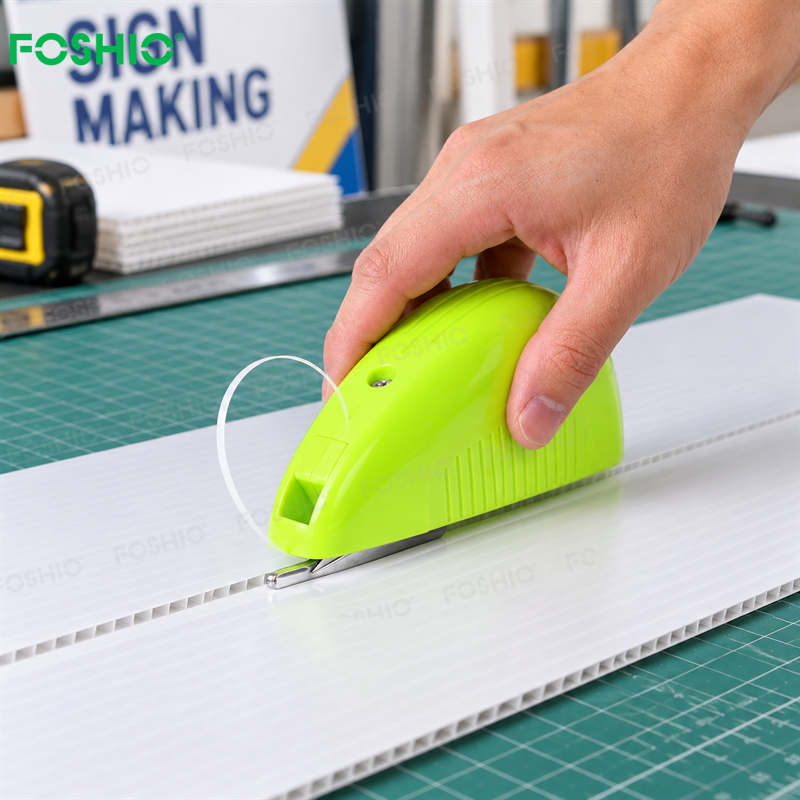
Twin-wall fluted polypropylene is mostly air. That single fact explains almost every bad cut:
For a sign shop the cost is rework. For a packaging operation it is worse: a crushed flute line on a custom insert is a weak point in a box that is supposed to protect something.
The three-step fold
This is the workflow the tool was designed around, and it is worth doing in this exact order:
1. Score along the flute line.Draw the fold line, set a straightedge, and pull one light pass along the line — with the flutes, not across them. One skin opens; the ribs underneath stay intact.
2. Bend cleanly along the score. Lift the panel and fold it away from the cut face. The intact skin on the other side becomes the hinge, and the ribs close up inside the corner rather than snapping.
3. Fold into a 90° shape.Because the hinge is a real hinge, the corner holds its angle instead of springing back, and the outside face stays clean — no white break line where the customer can see it.
Do it in that order and the corner looks manufactured. Skip step 1 and try to bend the panel cold, and you get a crease with a crushed radius that never sits square.
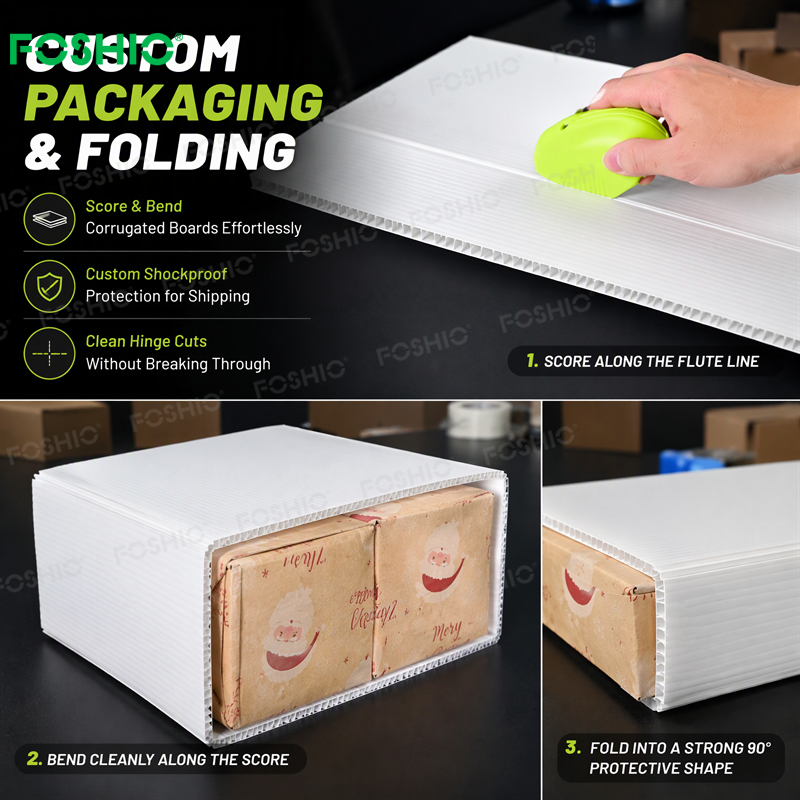
The packaging use is the one buyers underestimate. A scored-and-folded coroplast cradle takes a few minutes to make, weighs almost nothing, and holds a product far better than loose fill — which is why the same tool shows up in both a sign shop and a warehouse.
What is the difference between scoring and cutting coroplast?
Scoring cuts one skin and leaves the other intact, so the panel can be folded along that line. Cutting goes through both skins and separates the panel. You need a score for a fold and a full cut for a blank.
Which way do I score to get a clean fold?
Along the flute direction. The blade opens the top skin without crossing ribs, and the intact skin on the opposite face becomes the hinge.
Can I cut a panel to size with it as well?
Yes. With a straightedge and a cutting mat, a continuous full-depth pass gives a straight sizing cut. Work across the flutes where you can.
Will it work on thick multi-wall panels?
It is designed around twin-wall fluted PP sheet. For heavier panels, score in two or three light passes rather than one deep one — the same technique that keeps the face clean.
Does it replace a utility knife in a sign shop?
It replaces it for coroplast. Most shops keep both: the scorer for anything that will be folded, a knife for general trimming.
Does it work on solid PVC foam board?
No — solid boards behave differently and need a different blade geometry. This tool is for hollow fluted PP sheet.
Can we order a sample, and can it carry our logo?
Yes. Samples are available before a bulk order, and custom logo is supported for distributor and private-label programmes.
Categories
latest blog
For inquiries about our products or pricelist, please leave to us and we will be in touch within 24 hours.


© Copyright: 2026 Guangzhou Foshio Technology Co., LTD All Rights Reserved

IPv6 network supported
Scan to wechat



 English


